

These were my favorite non-fiction books of 2023 in no particular order.
The Cost of Sexism
Author: Linda Scott
This was a really insightful book about the literal economic cost of sexism in the world. The author has worked in international development, so doesn’t just concentrate on Western countries.
This was a brilliant look not only into the opportunity cost of women not being included in formal workforces around the world but also about how the ways we structure our societies and economies around men brings objectively worse outcomes for everyone.
It was incredibly eye-opening and sobering, and a great companion to other books that shine a light on the impacts of structural sexism such as Invisible Women by Caroline Criado-Perez.
War in the Blood
Author: Chris Beyrer

This was a book I picked up for my Around the World Book Tour, though it covers most of Southeast Asia, so I didn’t actually attribute it to any single country. The book covers the causes and treatments of the HIV/AIDs epidemics in different countries in Southeast Asia. The author was a public health worker who worked in the region during the nineties and again in the mid-2010s. He reflects on the contributors to the epidemics when he was first in the area and how that has improved, deteriorated or stayed the same twenty years later.
I found this very interesting, as he reveals that the causes in each country vary and the effectiveness of solutions vary place to place, largely based on the willingness of political powers to listen to experts and enact measures that actually address the epidemics. He gives examples of how Burma’s system of incarceration largely exacerbated the problem whereas Thailand’s promotion of condoms greatly helped prevent the spread.
What really struck me about this book was the exposition of something we’ve all (unfortunately) experienced thanks to Covid: that when it comes to epidemics of disease, medical treatment is not enough on its own to fight the spread, and that the leaders that are in place and the things they value (i.e. human life vs. economy or effective prevention/treatment vs ideology) can make all the difference in what the outcomes are.
I found the book incredibly engaging and accessible, and would recommend even if you’re not particularly interested in AIDs or epidemics: it’s a fascinating look into the various ways culture, society and politics impacts how different countries deal with the issues they’re faced with.
Hired
Author: James Bloodworth
Over the past few decades, jobs in the West seem to have been getting worse. Not all of them, and not only in the West, but we’ve seen a convergence of phenomena such as decline of unions, loss of careers, and the general diminishing power of people who work for a living (as opposed to those who own the means of production, i.e. capitalists who largely live off the work of others).
James Bloodworth demonstrated how perilous work can be as he took on the challenge of working in a series of low-paying but largely critical jobs. He experienced the precarity of low income against the high cost of living as well as the drudgery and alienation that many of these jobs bring.
This book is unique in that the author didn’t just interview a series of people who worked in these roles but performed them himself, using only his wages from the work to support himself to get the full experience of what it is like to survive in this kind of work. While working for Amazon, he found himself using food and drink to cope with the exhaustion and degradation he felt from being treated as a robot. During his time as a care worker, he only lasted a few weeks due to the physical and emotional toll it took, and he saw how unrealistic schedules and a shortage of carers led to poor outcomes for the elderly and people with disabilities for whom he cared.
This is the sort of book that should be on the reading list of every single politician in the UK (and the world, but I’ll take the UK for now as that’s where the author did his work) as well as any person who has ever scoffed at the support that anyone who struggles in these jobs gives to more radical parties like UKIP. If you’re wondering why people are pissed off about the state of the country, there are, of course, other things to consider, but this is an excellent place to start.
Tenants
Author: Vicky Spratt

This book was a sobering look at the frontline of Britain’s housing emergency. Even in a mostly up-to-code place with a decent landlord and a rent and income that allows one to afford to live in a place and heat it and feed themselves, renting can feel temporary and unstable. You don’t know if the landlord is going to decide to sell up and boot you out or if that new Tube station opening will motivate them to add a few extra hundred pounds a month to your rent.
All of this is made infinitely worse when the place you’re living is dank, damaged, decaying or dangerous not to mention when you can’t afford it at all. Throw in an underfunded and understocked public housing system, ridiculous rules that force people to be literally homeless before the state will help them, and again, it’s any wonder why people in Britain are willing to vote for anything claiming to challenge the current status quo.
The place we live is our home, even if we don’t own it, but in the UK (or the US for that matter), the insecurity of private renting along with the state in which our home is kept, which, as a renter, you can have only so much influence on, has an incredible impact on our physical and mental health and our sense of stability. The characterisation of housing as a commodity or an asset rather than part of the core structure of human lives has resulted in an increasingly fragile and unjust system where landlords are able to essentially hold the country hostage in order to extract money from tenants and taxpayers without offering much of value in return while renters are forced to constantly move around to find “affordable” housing while being locked out of the market to buy by the double whammy of surging house prices and rents.
Tenants covers all of these problems, from the decline in social housing stock and underfunding of the system to the criminally negligent landlords and companies that use their position to extort people. It’s a stark look at the state of private renting in the UK and should, again, be required reading for all UK politicians. Like Hired this is another recommendation for anyone who wants to understand the undercurrents of agitation rising in the UK.
The Meritocracy Trap
Author: Daniel Markovits
In a similar vein to Hired and Tenants, the Meritocracy Trap details some of the systemic forces feeding growing inequality in the US and UK. If you’ve read Michael Sandel’s Tyranny of Merit, this is another great companion that talks about how meritocracy perpetuates itself in a way that is anything but meritocratic.
In short, it argues that the focus on individual accomplishment in a world in which such achievement is largely shaped by the environment in which you grow up (which is entirely determined by luck) leads us to a continual cycle of generations one-upping each other on their devotion to work and productivity.
Markovits traces a line from the origins of meritocracy (where we divorced from a system in which your birth determined your status just by virtue of being born into a certain family) to today’s world where there is a growing divide between the haves and the have-nots in a way that almost mirrors the good-ole’ aristocratic age except that instead of being able to rest on their family name and titles and land and such, wealthy elites have to increasingly justify their place at the top through checking boxes such as prestigious schools, endless extracurricular activities and eventually jobs that may pay a lot of money, but cost nearly every waking hour of their lives and more than a little of their souls. And in order to ensure their offspring are able to enjoy the same benefits, they must ensure they go to even better schools, have even more extracurriculars, and bribe whoever is needed to get them into the best universities where they can make connections and get hired at the companies that both confer the same status in terms of salary and prestige but demand ever more of them.
True, there were parts of this book that concentrated very much on the (albeit legitimate) struggles of those uber-high achieving individuals who found themselves with all the markers of success and status as well as all the symptoms of stress, burnout, existential crisis and general fatigue, where I (as well as many other readers, I’m sure) probably rolled our eyes and whipped out our tiny violins. But what I found more compelling in this book was the observation of the cyclical pattern of achievement, success, monetary reward and then increase in work to justify such reward and the impetus to repeat the whole cycle with the next generation. The book really got into one of the driving forces of inequality, particularly in the US, and offered some really interesting food for thought about a system that many of us have accepted and internalised unquestioningly for most of our lives.
In Search of Kazakhstan
Author: Christopher Robbins
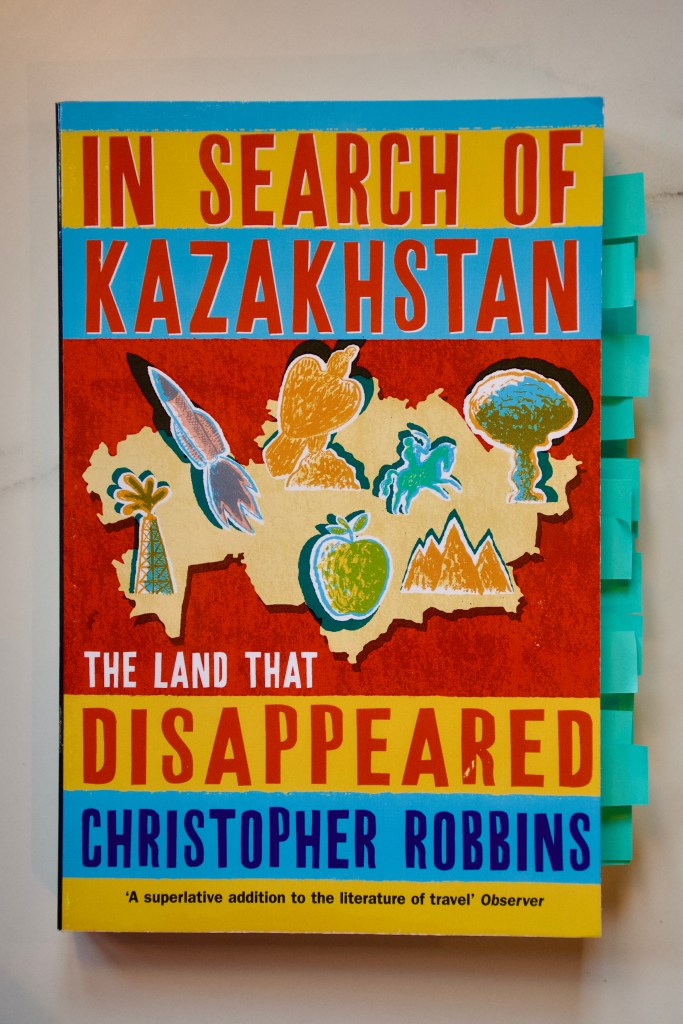
When browsing through Daunt for my next set of books for my Around the World Book Tour, I came across this one in a section on Central Asia. I was actually more focussed on Southeast and South Asia, but the title and blurb intrigued me as I didn’t know much about Kazakhstan. Upon starting the book, it was clear that a similar curiosity had befallen the author, which had motivated him to write the book in the first place.
In Search of Kazakhstan is an intriguing travelogue that both followed the author on his travels through the massive country that is Kazakhstan (it’s over three times the size of Texas) and weaves in stories about the people he meets and the history of the places he visits. Starting my Around the World Book Tour, I was initially wary about travel writing as some of it seems to lean more towards memoir, which is fine, but not what I’m after as part of this project, but Robbins did a fantastic job at giving insight into daily lives of Kazakhs as well as some of the history (notably membership in the Soviet Union) that has shaped them.
Gigged
Author: Sarah Kessler
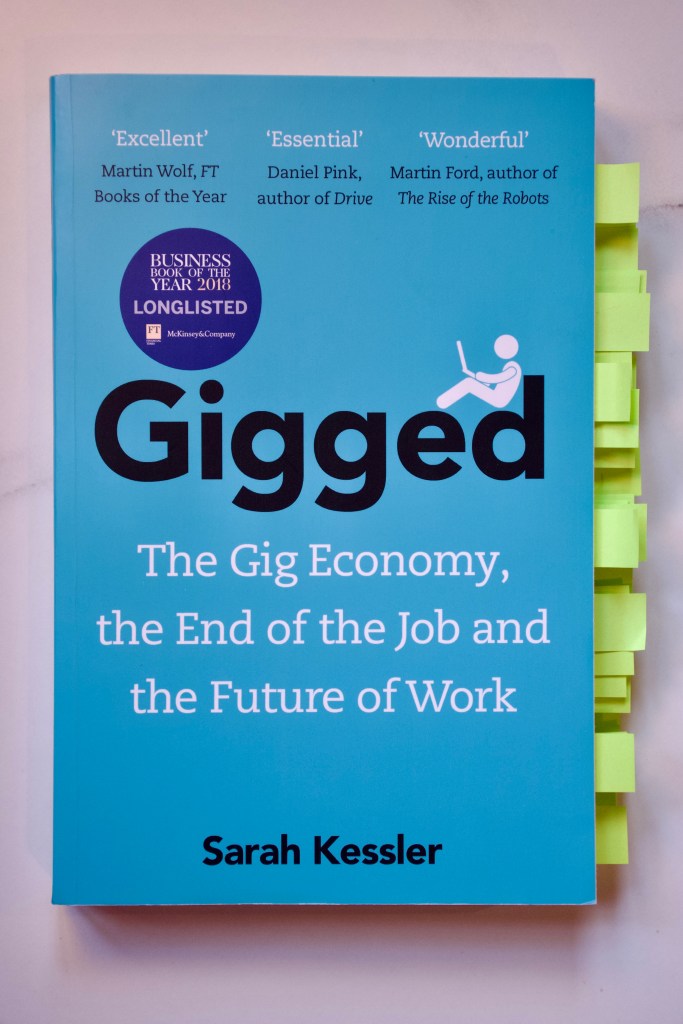
This is a great companion for Hired if you’re interested in the changing nature of work. The author concentrates more on gig workers in the United States. She interviews workers from a range of gigs, exploring why they chose the work as well as the benefits and drawbacks. The book also reviews some of the history of the rise of gig work and includes stories from a range of workers from Uber drivers who got into the business due to a lack of options to skilled tech workers who gave up lucrative traditional jobs to freelance because it better suits their schedule.
The book also looks at the other side of the gig economy, notably the companies that employ contract with gig workers and the Uber-ization of businesses for everything from hotels and taxis to office cleaners and labelling data for AIs.
 The Kat Bite