Author: Brandon Sanderson
Rating: ⭐⭐⭐
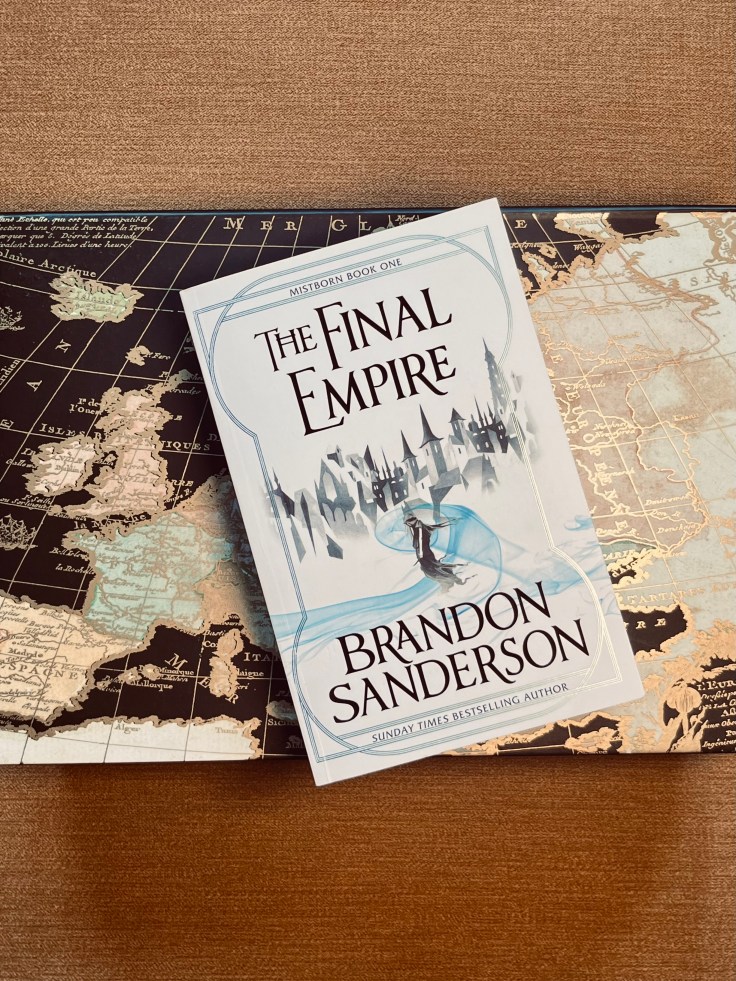
I picked this book up in an effort to try out fantasy books by male authors. Most fantasy (and most fiction in general) that I read is written by people who don’t identify as men. It seemed appropriate to start with Sanderson as he’s one of the biggest authors in the fantasy genre, and his books, particularly this series, are often recommended as a good intro to epic fantasy.
In this book, we’re following a group of criminals who are hired by a rebellion in order to overthrow a theocratic empire ruled by an evil god-king. In this universe, there is a strict caste system where the majority of people are called skaa, and they’re basically slaves, controlled by the nobles who rent them from the evil god-king: the Lord Ruler.
There’s also a magic system called allomancy which allows users to use different metals for different magic powers. Mistings can use one metal and one power and Mistborn can used all the metals. Allomantic powers are concentrated in the noble classes and skaa will only have them if one of their close ancestors is a noble.
The two main characters we are following are Kelsier, a thief who had previously been caught and thrown in a death camp from which he has escaped by the beginning of the book; and Vin, an orphan who grew up working in skaa thieving crews. Early in the book, Kelsier realises Vin is a rare skaa Mistborn like himself, and, because of this, she is given a place in the crew trying to overthrow the Final Empire.
I can see why this book is often recommended as an “intro to epic fantasy”. The world and magic system were fairly simple and well-explained, and the world-building which can often be overwhelming for fantasy newbies was done well in that it wasn’t too infodumpy.
While I generally had a good time with this book and would recommend it, there were a few things that stood out.
The first was the pacing. A lot of fantasy books are chunky. Especially, high fantasy requires page count for world building and magic systems that contemporary non-fantastical books don’t. And Brandon Sanderson in particular is responsible for some very big books. Many of his Stormlight Archives books are 1000+ pages per book. However, I felt like this book could have been shorter if some of the scenes had been tightened up. There were times where it felt like we were really meandering through conversations or fight scenes in an excessive amount of detail. This may be personal preference, or maybe I’m an impatient person, but I was reading through, wishing that the characters would get on with it.
The next issue I had was with relating to the characters. In typical epic fantasy fashion, there are some high-stakes scenes and what should have been emotional moments. When they happened, I was disappointed to find myself unmoved. One of the things I love about reading is getting emotionally invested in the characters. You don’t just care that someone is overthrowing the evil empire, you specifically want to see them overthrow it. I’m sad to say I didn’t feel as much of that specific character connection, so some of the moments that should have been emotionally taxing fell flat.
And the last and most significant, for me at least, was the treatment of women. It was unsurprising given we had a race of slaves that included women to learn that it was not uncommon for the nobles to sexually assault the skaa women. An extra level of grossness was added when we learn that an expected method of preventing bastards from these relations was to have the woman killed following some number of encounters with the nobleman. This is not just because of a cultural disdain for bastards but because obviously a large number of skaa children potentially having allomantic powers would be a threat to the caste system.
I understand that this element of the world was there to show how evil the Lord Ruler and the nobles were, and it’s existence alone is not my problem. The issue is that, against this backdrop, we get really scant female representation. We of course have Vin, one of our main characters, but she’s an oddly naïve 16-year old and apart from her, there are no other significant female characters. No one helping the crew (other than unnamed servants), and there are about two named noblewomen who play any part in the plot, though they maybe get 10 pages between them in a 600+ page book. In addition, off page, we have not one but two dead wives or girlfriends motivating male members of the crew to act.
This severely limits the agency of women in the story and makes them either motivators for men or devices to show how evil the villains are. Some might argue that this is a realistic portrayal of women in a patriarchal, misogynistic society, but I don’t think it is. No matter what kind of shitty society women have existed in (or do currently exist in) they always find little ways to rebel as well as ways bond and share information, especially if they are not physically kept from each other (which they are not in this world). Especially when they are under threat in this way (not only of being sexually assaulted but killed after), there would be some kind of network of wise grandmothers who had managed to escape this fate and supported the younger generations.
I felt like this lack of representation was both a missed opportunity and added insult to the injury perpetrated on skaa women as a whole, so I hope it improves in the future.
That being said, I’d still recommend this book as a good start to epic fantasy, and I’m keen to see how it develops in the series.


Leave a Reply