
Some thoughts on the non-fiction books I read in January.
The Right to Sex
Author: Amia Srinivasan
Rating: ⭐️⭐️⭐️⭐️
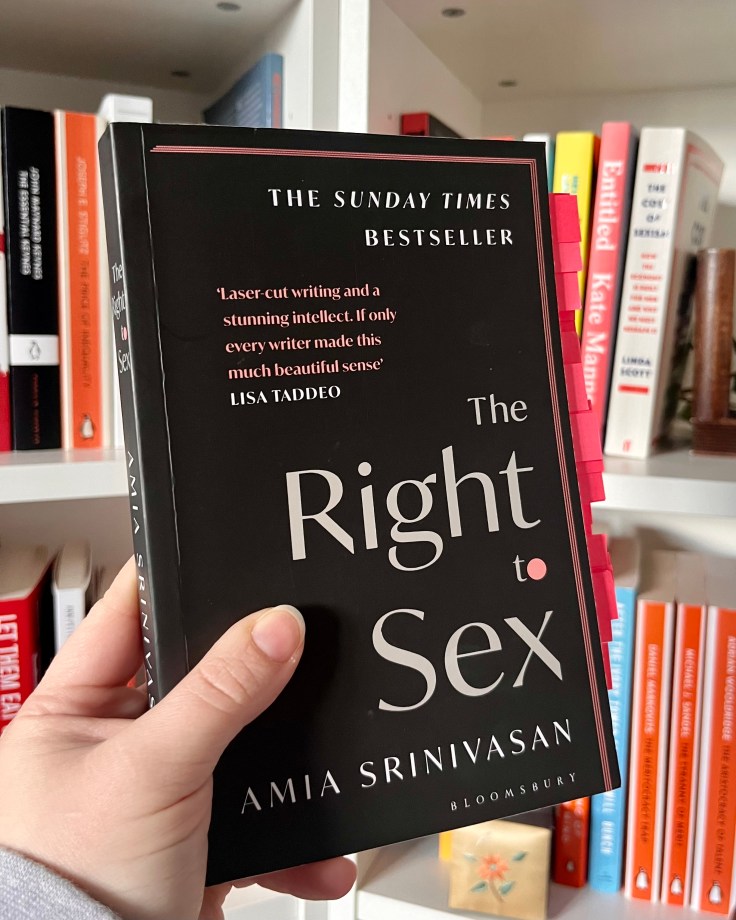
This book is a wonderful starting point to understanding feminist theory specifically focussed on sex. In this series of essays, Srinivasan discusses ongoing themes in current events such as #MeToo, the responding proliferation of incel and men’s rights dialogues, intersectionality in feminism and the portrayal of women in porn.
The author makes insightful, logical arguments in a succinct and precise manner, but this is also one of those books where you have to pause and think about what she’s saying. It made me reconsider a lot of things that I’d either only ever thought shallowly about or never considered from the angles from which she presented them.
All of the essays were fascinating, but one that stood out to me was about the harms of university-level professor-student relationships on female students (particularly in male professor-female student relationships, which is the most common iteration of these pairings). Even though the topic was discussed in a university context, the reasoning presented has implications outside of universities (for example, in the workplace). Even when they’re consensual, aside from power imbalance and the social and academic stigmatisation the female student is likely to face, she points out that the job of a professor is to be teaching their students. When the professor makes clear that he sees his female student as sexually attractive, he changes their relationship whether or not they go on to engage in any romantic or sexual relationship.
“For women do not enter or exit in the classroom on equal terms with men. They are assumed to be less intellectually capable, encouraged to take fewer risks and be less ambitious, given less mentoring, socialised to be less confident and take themselves less seriously, told that evidence of a mind is a sexual liability and that their self-worth depends on their capacity to attract men’s sexual attention. They are groomed to be caretakers and mothers and doting wives rather than scholars and intellectuals. […] [W]e might ask: If I know that my professor sees me not (only) as a student to be taught, but (also) as a body to be fucked, how self-possessed, how exuberant can I feel sitting in his classroom?”
(p. 139) The Right to Sex
An overarching thread through many of the essays including the quote above was that in order for men (and women) to see the impact of men’s actions on individual women, we can’t look at the relationship between the man and the woman in a vacuum. We all exist in a certain social, political, economic and cultural context where women have been socialised differently than men, and the way men might intend actions, as harmless or playful or completely open to rejection is not the only consideration happening in a woman’s mind when she responds to them.
As Srinivasan points out, this isn’t an individual man’s fault. He doesn’t create the context in which a woman exists and he may do his best not to contribute to it. But because he isn’t in that same context, he doesn’t see how his actions, however mild or unthreatening he is intending to be, might be perceived differently by her. I think this is a useful framework for both men and women to have in these sorts of situations. I know it made me re-think relatively mild interactions I’ve had with men where there was nothing overtly threatening about them but that made me supremely uncomfortable and I’ve now realised it was because my brain was working on another level that I wasn’t even aware of at the time.
All this is to say, I really enjoyed these essays and I found them highly relevant, witty and brilliantly reasoned.
The Power of Geography
Author: Tim Marshall
Rating: ⭐️⭐️⭐️⭐️.5
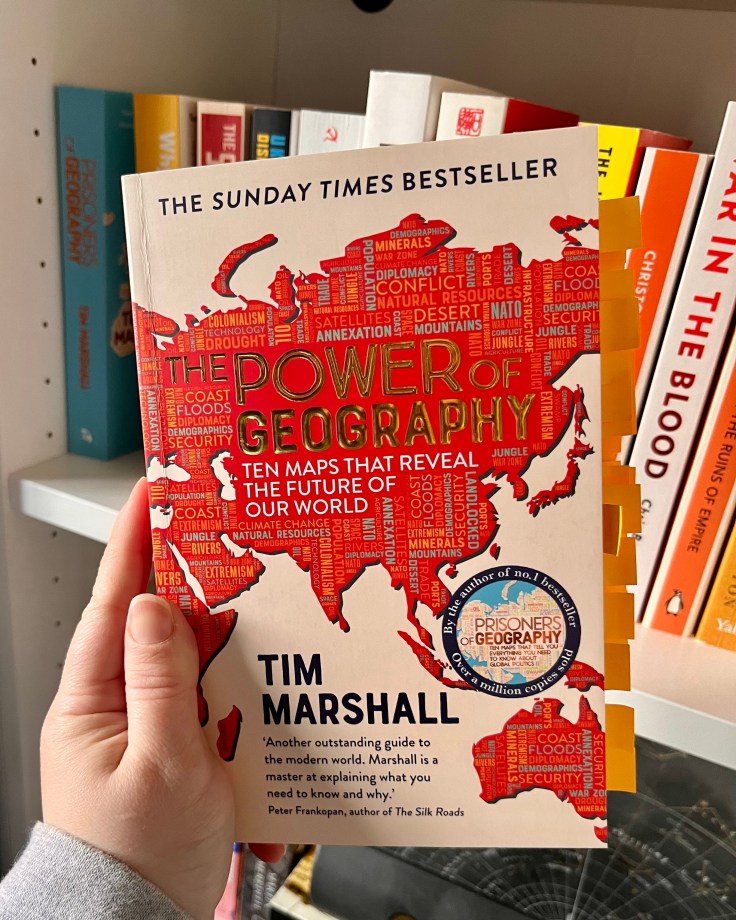
In this book, Tim Marshall takes us through nine countries/areas of the world in addition to space and talks about how their geography has shaped them. This is not dissimilar to one of his previous books, Prisoners of Geography, that concentrated on nine different countries and the Arctic.
Marshall’s argument is that geography heavily influences how states form, their ability to maintain control over an area, their economic options, and the overall geopolitical framework that all states exist within. In addition to talking about mountains, navigable rivers, deserts and natural resources, each chapter gives some background into a country’s history and society and how that has been shaped by or interacted with their geography. This is important because geography does not make what humans do a foregone conclusion. Technological development has allowed us to overcome geographic obstacles and has made new parts of Earth’s geography relevant in a way that it wasn’t even a hundred years ago.
The last chapter in this book is on space and how control of different levels of Earth orbit will be relevant in the next century as the area around our planet becomes crowded with satellites and control of levels of orbit may influence space exploration or colonisation.
The chapters pack a lot in, and are a great primer for beginning to understand geopolitics. Obviously, with the breadth of places covered, there is not a huge amount of depth, but that’s to be expected, and will open doors to further exploration.
Debt: The First 5,000 Years
Author: David Graeber
Rating: ⭐️⭐️⭐️⭐️
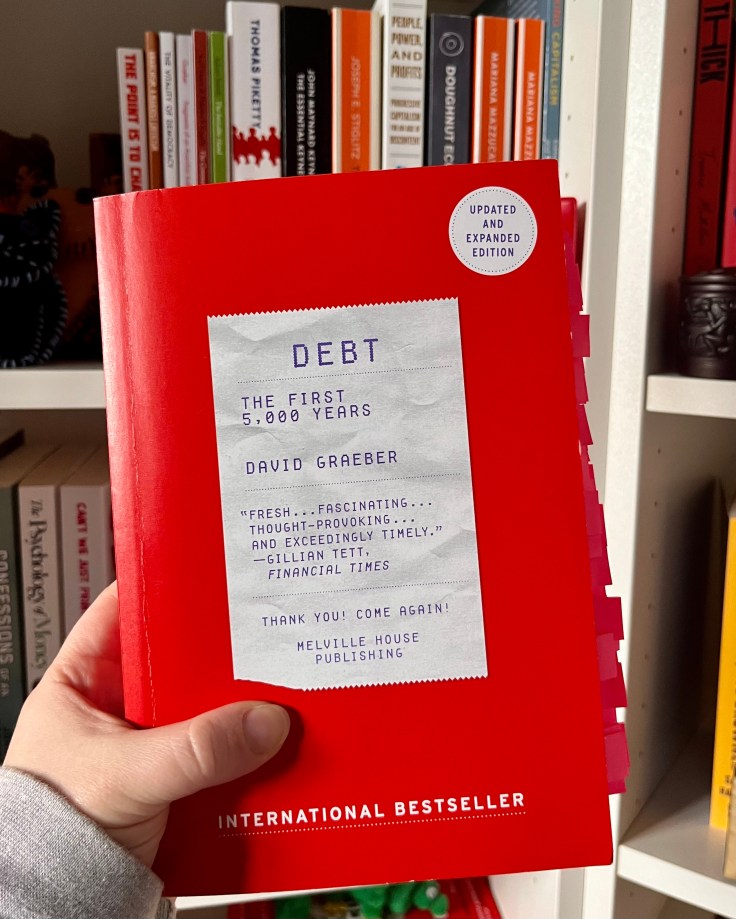
Unlike The Power of Geography, this book had a lot of depth. This book was written by an anthropologist, and it shows. Graeber doesn’t just focus on financial debt (though that is covered at length) but also different ways in which humans have organised themselves and the concept of debt not just in monetary terms but also as acts that must be repaid and the moral/ethical implications that has been assigned throughout history.
He spends a lot of time debunking our understanding of why we use money: the myth that it was invented because the barter system (I give my neighbour a sack of potatoes for some shoes) was wildly inefficient (what if my neighbour doesn’t want potatoes). He argues instead that people likely operated in a system of debt, essentially an informal IOU arrangement where something given to you by your neighbour now would eventually be repaid in kind. He discusses how traditional state-backed currency was first popularised and utilised through force of taxation. (Why should I accept this small coin for my potatoes? Because some man with a sword and the ability to lock me up is going to come by and insist I give him a handful of these coins at some point, so I might as well build a stock of them.)
A lot of the things he covers are relevant to understanding modern problems like the implications of massive amounts of debt held by either individuals or states (particularly poorer countries). I found his explanations of the origins of currency very relevant to understanding cryptocurrency and what it would take to make that useful as a method of payment.
This is one of the first books that I’ve felt the need to heavily annotate with questions and arguments, particularly when he was talking about human economies and the patriarchy, which I felt was splitting hairs, especially as he discussed historical phenomena of women being used to settle debts. I also did find some sections overly long and repetitive, which may be because this book was originally geared towards an academic audience where backing up your argument with an overabundance of evidence is expected, but as a lay reader, it just dragged and made it harder to get through.
This is the third book from Graeber I’ve read, and what I always love about his writing is that he doesn’t take anything for granted. He will challenge everything and force you to reconsider why you think the things you do and what the basis for your beliefs are. He’s like that crotchety uncle at Thanksgiving who won’t just let you make a point and will question everything you say in a way that makes you think more critically. As annoying as that can be, I think we all need one of those (at least sparingly), especially when it comes to discussing subjects with such wide-ranging implications as debt.
 The Kat Bite