
Author: Sean McMeekin
Rating: ⭐️⭐️⭐️⭐️
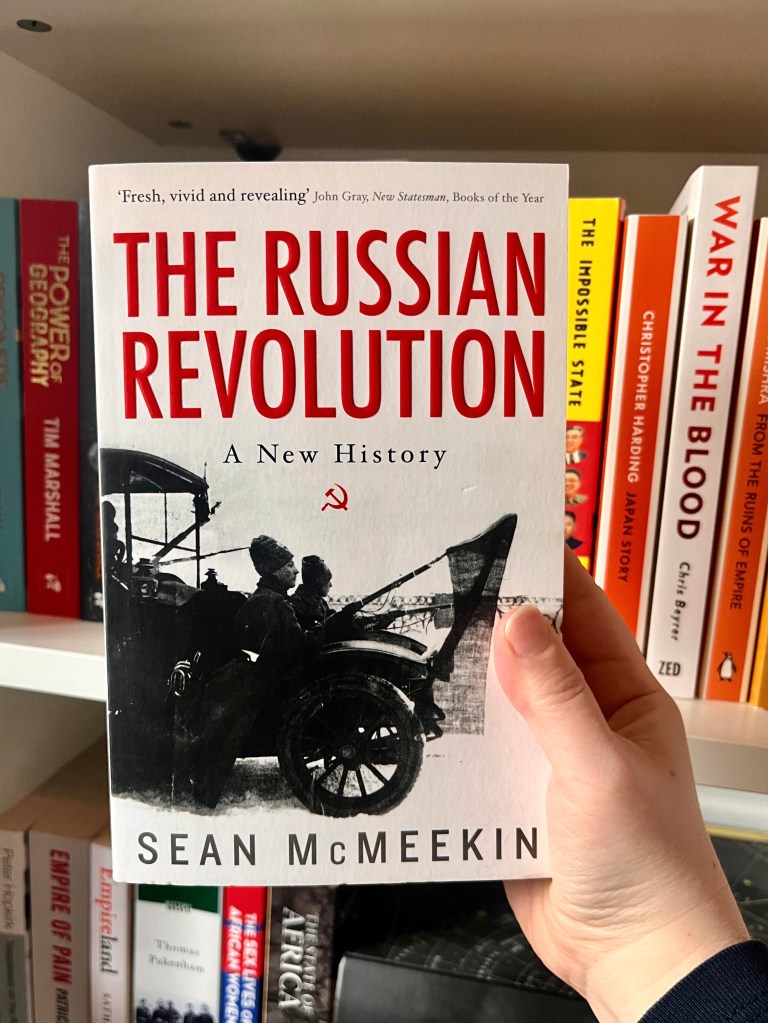
This book is a very thorough look into the Russian Revolution, tracing the movements and interactions of all the significant players, including the imperial family, the various governments, the Bolsheviks and the military.
Having never studied Russian history in much detail, the Russian Revolution has always been one of those events that was always mentioned as formative for our current geopolitical order, but it’s usually summed up as the tsar and his family being executed and the Bolsheviks marching in.
What I enjoyed about reading about it in more detail was understanding all of the machinations going on, not only among various power-players within Russia, but also countries outside it. Key among these plans was the fact that the Bolsheviks were supported by the Germans in an effort to destabilise Russia and get it out of World War I, which they were eventually successful at doing.
This book made me think a lot about the power of people. One of the reasons for the Bolsheviks’ success was their ability to sow discord in the military, which was being drawn increasingly from various peasant communities as World War I churned through career soldiers. This both reduced the military’s efforts to suppress them as well as increased their influence.
Common people usually outnumber the ruling elite, but those elite generally manage to control some sort of army, which keeps people in line. However, if that army is pulled from those same people they’re supposed to be fighting against, it’s not likely to bode well for whoever’s trying to control them. This theme is repeated in other revolutions and civil wars.
This also manifests itself in non-violent ways, as the Bolsheviks found out when they attempted to actually start governing. Governance isn’t just making up laws and policies based on whatever ideology you stand behind. At some point you actually have to implement those laws and policies, and for that, you need people, key among them civil servants but also workers. Theoretically, the Bolsheviks knew this as that was part of the basis of their ideology, but they vastly underestimated how coming in and ripping up the rulebook would go over with the people.
Critically, when the Bolsheviks took power, they needed money, which was kept in the banks. But the banks, in protest of what they saw an illegitimate seizure of power, refused to give them any money. “The State Bank and Russian Treasury remained open to honor obligations to soldiers and state employees, but they refused to release funds to the Bolsheviks.” (p. 219) Lenin had to resort to kidnapping bank employees and holding them hostage to extract money from the banks.
Another thing this book (and the events within it) reflects well is how all systems of power, whether they be political, economic, military or otherwise, are man-made. Some people like to argue that there are natural laws governing the economy or relationships between countries, or relationships between people, but any of these “rules” are just a way to bring sense of order to the world (or an attempt to control it). During the Russian Revolution there were several iterations of groups in power. Sometimes multiple groups made conflicting claims simultaneously. The only time they had any actual power was when people, and importantly the ”right” people believed in them. The right people were sometimes the people who held the guns or the money, but they were also the people who drove the trains or worked in the factories or grew the food.
In most stable, democratic, rich countries, those systems of power are so complex and ingrained into our understanding of how the world functions, that I don’t think we think critically about them much at all. This seems to be changing though, especially in a post-pandemic world as there is more discussion about the role and responsibilities of government, corporations and people and particularly as the issues that affect us all are so often intertwined with and dependant on issues and conditions in other parts of the world.
Overall, even as someone who doesn’t usually love history books, I found this accessible, comprehensive, thought-provoking, and enjoyable.
 The Kat Bite