
Author: James C. Scott
Rating: ⭐️⭐️⭐️⭐️
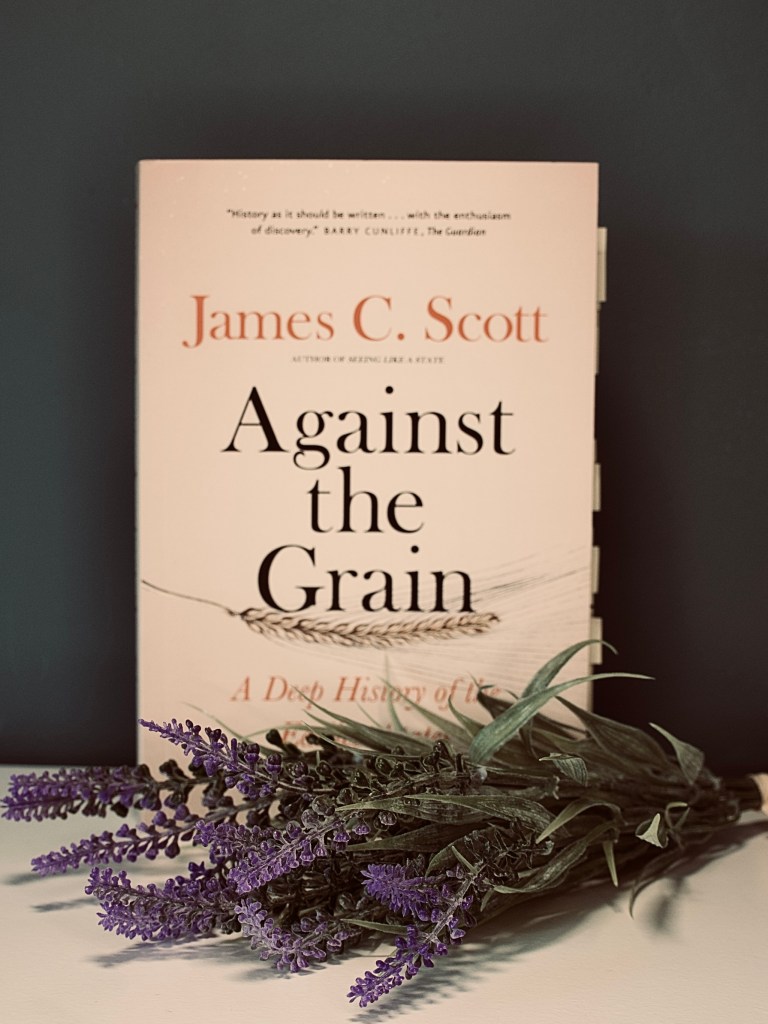
When I started this book, I thought it would be a slightly dry and moderately vain attempt by a Political Scientist to stretch into several other social sciences to cobble together a mildly interesting theory explaining things that happened thousands of years ago that likely had little relevance today. And I don’t think I can be judged too harshly for this assumption because the author did spend many pages of the introduction insisting that he was very much an interloper into fields of anthropology, archaeology and history and that this book contained no original research nor anything new. He subverted expectations a little too well.
What I got instead was, granted, some dry history on what early humans ate but in later chapters a recitation of the development of agriculture and the rise of states and the realisation that literally nothing has changed in the function of states since they were created.
Scott starts by discussing the role of agriculture in early states and debunks the myth that states were the reason we stopped hunting and foraging and developed the system of sedentary farming and livestock rearing that now feeds most of the world. He argues that plant and animal domestication existed in pre-state societies, although he does acknowledge that early states had a great influence on what kind of crops were grown (for example, many states grew grain because it was easily divisible, transportable and taxable).
Some of his key observations are:
Hunting and gathering was generally easier than early agriculture and could still be done by sedentary communities in the right environment. Agriculture, especially early agriculture prior to the invention of tools and machines that have been created for the purpose, was dull, monotonous, backbreaking work. And after planting and tending to the plot of land containing your source of food, not only were you up against mother nature and the capriciousness of weather, but you also had to defend your crops against every weed, pest, animal and human also looking to have a piece of your crops.
However, agriculture allowed humans to create surplus. Surplus food meant more people could focus on other things than foraging, which is how states became more systemically important. With the accrual of extra resources (whether food or material objects) comes the need for protection of those things as well as larger volumes goods for trade and more complex systems of exchange, which necessitates administration.
To produce more surplus food/goods and facilitate activities such as building more complex, permanent cities and methods of exchange, states relied on slaves. For larger sedentary populations to protect themselves and their possessions against nomadic raiders and to produce enough surplus to sustain trade, early states required not only more agricultural labor but more complex industry: mining rocks to build walls and building the walls themselves (and eventually building giant monuments to the rulers), as well as other “public works” such as irrigation to farmland or cities. And all of this was also miserable work, much of which was done by slaves. Scott maintains that states didn’t invent slavery but most relied on slaves to do much of the necessary work that allows the state to perform its duties (i.e. defence and public construction). In fact, much warfare was primarily motivated by the need to acquire material objects and labour to satisfy the growing appetites of early states.
The heart of any state was its people, without them, the state would collapse. Even as states grew or shrank or “collapsed”, there were always communities on the periphery, nomadic or not, who still either foraged, reared animals or practiced some kind of minimal agriculture and were either far enough from the reach of the state or small enough that they weren’t worth attempting to annex. This allowed people some degree of freedom from state oppression. If taxes or poor governance impacted people’s lives negatively enough that it outweighed any positive of being part of the state, then they could up and leave and exist outside it. Enough people doing this would often lead to state collapse because a state can’t function without its people.
What I found most intriguing about this book was that many of Scott’s observations on how early states functioned are relevant to understanding political and economic relations in today’s globalised world.
As someone living in the West in the present day, this concept of living outside the reach of the state is almost unthinkable, the realm of either neo-liberal billionaire tech-bros, religious cults, or preppers. In our current capitalist order, where all territory on earth has been claimed by one state or another, while there are still millions of people who live on the edges of states, those groups often still need to contend with states laying claim to the land on which they live and they are often some of the most vulnerable and marginalised communities, at risk of exploitation and violence by the state and lacking recognition, rights or protections of citizenship. In other words, while there might technically be somewhere to escape an oppressive state nowadays, those places are both shrinking and, for most people, not viable alternatives in terms of standard of living and access to resources that most modern states afford.
The fact that early states relied heavily on slavery to function also speaks volumes and draws interesting parallels with production of goods today. It’s uncomfortably acknowledged by many of us in the West that the minerals that go into our electronics, the food we import, the materials that make our clothes and the clothes themselves, not to mention nearly every bit of what I call random plastic crap that either serves utilitarian or decorative purposes in our homes are often the product of underpaid and exploited labour at some point in the supply chain.
For example, the laptop on which I’m typing this and the device on which you’re reading this may contain cobalt, which is an essential ingredient in lithium-ion rechargeable batteries. One of the largest sources of cobalt in the world is the Democratic Republic of the Congo, where cobalt is mined in absolutely deplorable conditions. It’s dangerous, dirty and difficult, and the people who do it make poverty wages. It’s the sort of job that most of us in the West would turn our noses up at if it were offered in the same conditions.
And this sort of thing has happened all over the world, throughout history. The Western leg of the Transcontinental railroad across the US was built in part by 15,000 Chinese labourers, who were paid less than their white counterparts. These men were brought in because of a shortage of men in the US who were willing to undertake the work. Fruit picking both in the US and the UK as well as other farm work is famously done by seasonal immigrants who are often paid poorly, charged for accommodation on the farms and sometimes debt-bonded to unscrupulous recruitment agencies in what is basically modern slavery. Similar trends are seen with labourers and domestic workers throughout Asia and the Middle East.
Scott points out that the constant demand for slaves (which spurred many conflicts enacted by early states) was driven by the desire to be able to take on these large projects such as building cities and expanding agricultural production while not having to break the bank, as it were. Free people will only endure so much crappy work[1], as evidenced by the above, so the alternative is for states to find someone even lower on the proverbial totem pole who has little other choice. In early states (and a lot of history) that was slaves, today it’s immigrants from and residents of low-income countries.
Chattel slavery may not be legal in most of the world anymore, but to some degree, states and our current global capitalist economy still rely on it to support our consumer culture, and from this we can see that, in thousands of years of so-called “civilized” humans, these structures haven’t disappeared, they’ve just stretched across the globe and cornered out what little free space there was left.
There are holes in Scott’s argument. One of the biggest is what motivated the shift to state formation. If people had the ability to exist on their own, why would they become part of a state that would take part of what they produced, especially in the day where democracy wasn’t exactly widespread? Was it coercion? This is, unfortunately, not adequately explained.
Scott both argues that early states rose and fell because people “voted with their feet” and would literally leave when they were too oppressed. But he fails to explain why there would be any bar for oppression in the first place. I would imagine this has something to do with the fact that humans have always existed collectively, and with any sort of collection of people, exist social rules and power structures even if they’re not as large or complex as states. This part of the picture is missing from his story.
It’s interesting to think that we exist in our current state structure because of the incremental development and expansion of the same basic apparatus over thousands of years, and for the most part, it’s become so engrained in our understanding of the world that we don’t even question it anymore. But what Scott does in this book is remind us that the concept and structure of states is artificial in that they are man-made like everything else in the world from society to politics to the economy. Nothing about these things is natural, which means they can be changed to suit what we want or need from them.
This is not a call to anarchy. Just because something isn’t natural, doesn’t mean it’s inherently bad or useless. Modern medicine, indoor plumbing and indeed, agriculture are all unnatural, as in: they are not found in nature, but all have a positive impact on our lives. But this book reminded me that humans have spent thousands of years actively shaping what we think of as “civilisation”, and that that work is both ongoing and requires active involvement.
[1] If you’re interested in how this currently manifests in the UK, I’d recommend Hired by James Bloodworth, who takes on a series of low-paid jobs in Britain and shares his experience and the experiences of others working in these places.
 The Kat Bite