
Author: Adrian Wooldridge
Rating: ⭐️⭐️⭐️.5
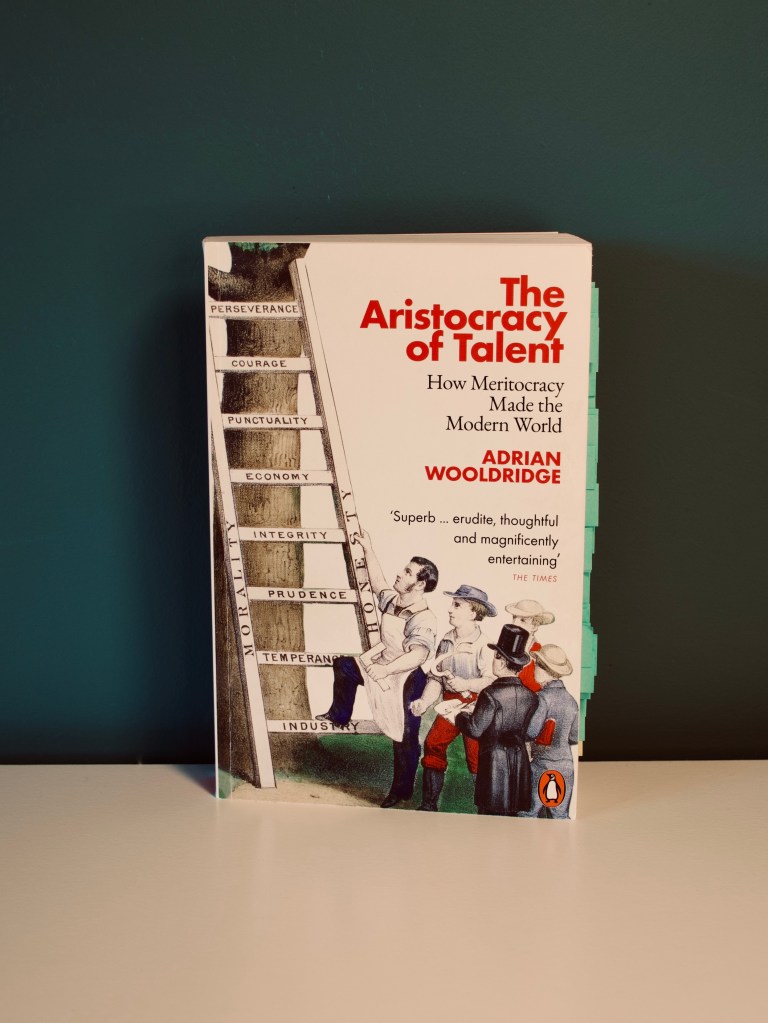
I had mixed feelings about this book. I’ve read both The Tyranny of Merit and The Meritocracy Trap. The first covers how meritocracy is a double-edged sword that both rewards people for effort but can punish them for failure and blame them for that outcome. The second reviews how the system can devolve into a self-perpetuating cycle that pulls apart society as already-wealthy people can ensure the success of their children in the system in a way poor people cannot, while simultaneously hollowing out the middle so that the world is left with a few interesting and well-rewarded though highly stressful jobs at the top and drudgerous, low-skilled, poorly-paid jobs at the bottom.
This book is very aware of the first two, and the author mentions both in the introduction. But it distinguishes itself from them by, for the most part, covering the history of meritocracy from ancient concepts of guardians by Plato to the origins of public schools in the UK—which, if you can believe it, started out as places where a large portion of the students were picked on merit, often from working-class families, and attended with no or low fees before transforming into the domain of children of oligarchs, royalty and the one-percent.
The history portion, which was most of the book, was largely fine. It was as engaging as history can be (for me), and informative on the subject, though it did concentrate heavily on the rise of meritocracy among white men. This book does have a heavy Western perspective, focussing mostly on the UK, US and France, though the author does dive a good bit into East Asia, particularly historic and modern China as well as Singapore.
But noticeably absent from many of the chapters were what was happening with women or racial minorities at the time. It’s possible that there wasn’t much happening with these groups when the white guys were fighting it out over whether inheriting a name or inheriting both natural talent and luck of an environment in which that talent could be nourished and developed made you better than everyone else. Likely these groups were excluded from these discussions because social and political movements based on class were only acceptable from the people who were most similar to those already in power. And while Wooldridge does have a chapter specifically on women (covering at most the condition of women over the past three hundred years), and he does acknowledge that much of the benefits of meritocracy in America were not extended to African-Americans, it felt very much like he forgot about them for most of the book and shoved some chapters and sections in to counter potential criticism of having too narrow a perspective.
While women and racial minorities may not have featured heavily in the most visible parts of the development of the meritocratic systems (e.g. open admission to universities and less biased hiring practices) that, as the author says, “made the modern world”, they were the invisible structure underpinning it. If we’re going to talk about merit, it’s important that we acknowledge what traits and skills are being considered as contributing to merit and who was allowed to exhibit or develop those traits and skills throughout history. Not to mention who was doing the housework, raising the children and working for pennies (or for free) to support the development of an industrial, capitalist economy to which meritocracy is so closely tied.
What I found most surprising, however, was actually the theoretical/philosophical conclusions that the author reached. To be fair, perhaps I am biased from my previous reading of Sandel and Markovits whose evidence of the current implementation of meritocracy being a bad deal for almost everyone has made me lean even harder towards the beliefs that we need a world in which we see merit in a broader context and acknowledge that all people, by virtue of being human, are deserving of basic rights and material provisions including food and shelter. So it was interesting, after hundreds of pages of history in which see how people have moved from the concept of desert being determined solely by birth to what is, frankly, a different set of criteria that is also largely determined by birth that Wooldridge’s takeaway was that meritocracy wasn’t broken in its core principles but had been corrupted and mis-implemented and needed to be reformed and expanded. His conclusion seemed to be that aristocracy was bad and modern day corruption is bad and that meritocracy is therefore the only way to counter either of these. This seems like an oversimplification and a misunderstanding of the key arguments against meritocracy writ large.
The problem with meritocracy is not on a micro-level, the level where we give jobs or university places or government contracts to the parties that are most qualified and best suited for them. The issue is on a macro-level where we:
a) conceive of merit largely as intelligence and grit or use financial success as a proxy for merit, ignoring other valuable traits like compassion or empathy,
b) reward people based on these skewed metrics and ignore the fact that someone’s abilities whether they be academic, athletic, artistic or otherwise are the result of a complex combination of factors including luck at birth as well as the environment in which someone grows up, which is heavily dependent on external economic, political and social factors, and
c) create a world in which constant achievement is considered the norm, the standard and the minimum requirement to deserve even a moderately comfortable life.
As you can probably tell from the length of this review compared to others, I have a lot of thoughts on this topic, and while I disagree with Wooldridge’s conclusions, I do appreciate the painstaking context-setting that is the bulk of this book. It did add to the debate and provide valuable information on a very important topic. However, if I were to recommend one book on meritocracy, it would be The Tyranny of Merit by Michael Sandel.
 The Kat Bite
Leave a comment