
Author: Ed Yong
Rating: ⭐️⭐️⭐️⭐️⭐️
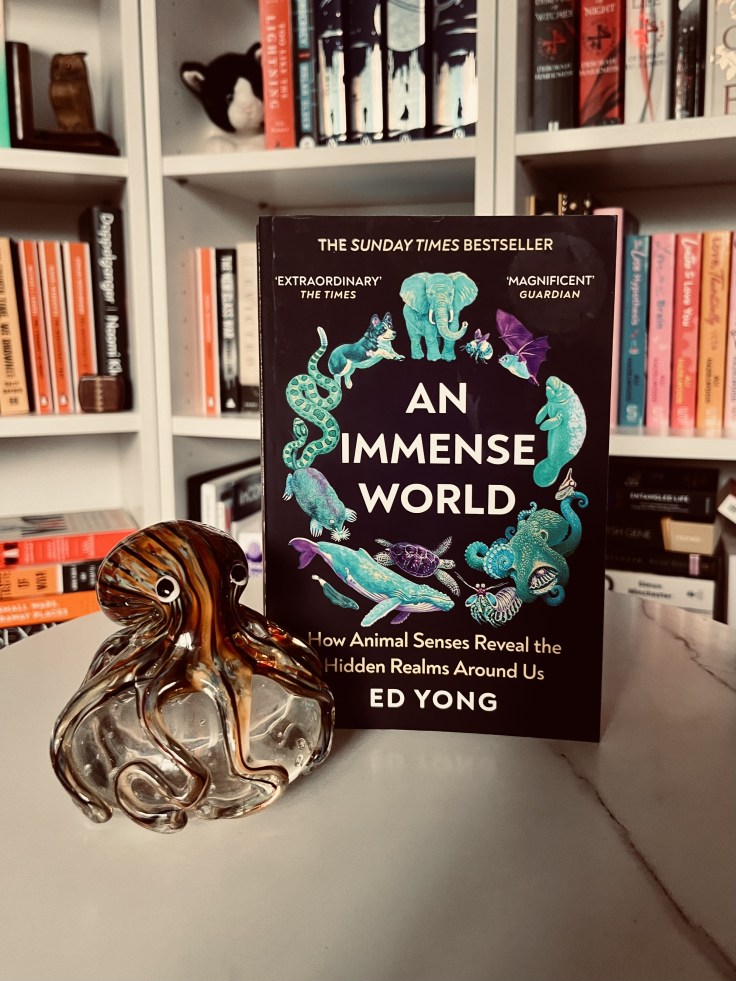
This book is a fascinating account about how animals sense the world. In each chapter, the author covers a sense, how it works, the kind of sensory receptors these animals have, and how they use that sense. He talks to researchers and conservationists. He visits animals both in labs and in the wild and talks about the limits to some of this research and how researchers devise tests to figure out how animal senses work.
For example, one of the most important senses many animals have is smell, and in his chapters on smell, he talks about the issues researchers face in trying to test how animals smell.
“Smells aren’t easily captured, so while scientists can photograph an animal’s displays and record its calls, those who care about olfaction have to do things like scoop up urine-soaked soil. Smells aren’t easily reproduced either: You can’t play back an odor through a speaker or a screen, so researchers have to do things like drive piss-soaked soil in front of elephant herds.” (page 37)
He gives the example of a researcher working on elephants who wanted to test the theory that elephants can distinguish other elephants and health information about them from their urine. She does this by observing elephant herds, and when one of them takes a pee, after they leave, she scoops it up with a shovel, puts it in a container and then drives around looking for some more elephants and quickly deposits the urine-soaked dirt in their path. If an elephant family comes across it, they’ll inspect the dirt.
“If it came from a different family group, they quickly ignored it. If it came from a family member who wasn’t part of their current unit, they showed more interest. But if it came from an elephant who was part of the same group and walking behind them, they were especially curious.” Because they’re clearly wondering how it got there.
So that’s just a fun example.
He also talks about, despite the fact that we’ve actually got pretty decently developed senses, there’s a lot of the world we miss. There are colours that exist outside the spectrum of what we can see (though some humans can see a wider array of colors), sounds that are too low or high for us to hear, and some of these noises are really loud, just outside of our range of hearing. After reading that chapter, I remember taking a walk and wondering if there was a cacophony of noise going on in my local woodland that I was missing out on because of my human ears. I am actually grateful for that, because I like my peace and quiet, but it’s amazing to think that there’s this whole world happening around you that’s outside of your perception.
He also talks about how humans are quite biased when it comes to thinking about senses, because our world is so overwhelmingly built around sight. And not only does that mean we’ve spent a lot of our history underestimating other animals, we also underestimate ourselves. In later chapters when he’s talking about echolocation, he describes how humans can actually echolocate. It’s something that blind people do, but isn’t often taught because it’s outside the norms of what we consider “socially acceptable.”
This book was a masterpiece. The amount of information in it is enormous, and it was such an interesting look into a subject I really didn’t know much about.
If you’re interested in animals, I would highly recommend this. The descriptions he gives are incredibly fascinating, and he puts the reader into the body of the animal as much as possible, and opens up a whole other world.
Also, if you’re someone who is looking to write science fiction with some creative aliens or magical creatures, this might be a good book to check out for some inspiration. Obviously, all of the animals described here exist, but some of their senses are so far outside of our everyday lived experience as humans, that it does seem almost alien.
 The Kat Bite
Leave a comment